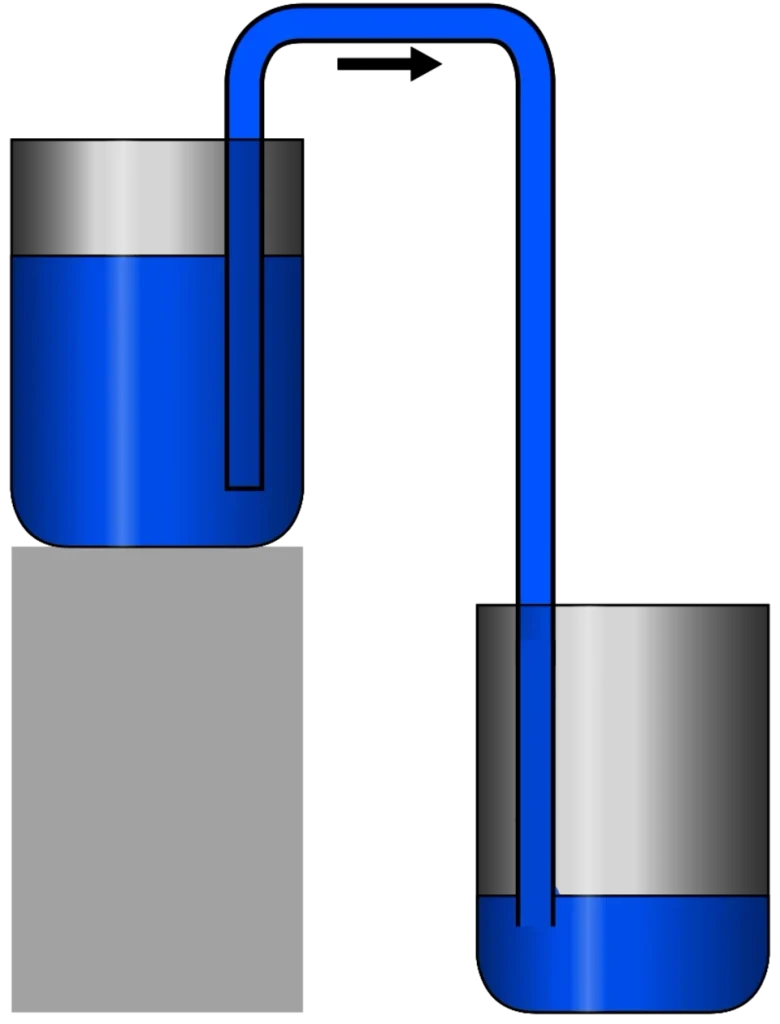
Axel-air, CC BY-SA 4.0 https://creativecommons.org/licenses/by-sa/4.0, via Wikimedia Commons
Introduction
Siphonage is an important effect to understand, why it happens, and why it’s a concern in waste-and-vent systems. But what is siphonage, exactly?
Definitions are always a useful place to begin, but defining an effect like siphonage in a way that’s understandable requires some unpacking. Skip ahead to “Siphonage, the effect” if you want to dive in immediately.
Ahead I’ll offer a general understanding of the concept of siphonage, why it is addressed in the code, and how it relates practically to plumbing applications.
First, I want to show why knowledge like this is valuable to have as a plumber.
Why definitions and technical understanding are important
An aspect of professionalism is that you carry around a certain degree of both expert action and knowledge.
Most tradesman are hands-on learners, and the greatest return on investment (ROI) when learning a trade such as plumbing will always be hands-on experience. Being able to actually go out and do the work will always trump conceptualizing things in a class environment.
On the other hand, putting things together isn’t enough. There comes a point when you must understand what you are doing in order to put together systems that are effective, or to be able to accurately diagnose problems within a system – one that you may only be seeing a part of long after it was plumbed.
C.S. Lewis wrote the following about words: “…to say the very thing you really mean, the whole of it, nothing more or less or other than what you really mean; that’s the whole art and joy of words.”1
Likewise, if there is art and joy to be found in plumbing, it is being able to both produce and avoid exactly what you want the system you are creating and installing to produce and avoid. That takes more than ability to glue pipe together – that takes knowledge.
Simply put, in order to do, especially effectively and efficiently, you have to know.
So, what is siphonage?
Siphonage, the word
The title of chapter 2 in both the International Plumbing Code (IPC) and Uniform Plumbing Code (UPC) is “Definitions,” but unfortunately, one won’t find the term “siphonage” in either one as a direct definition. Although that’s the case, the effect of siphonage is mentioned in several important, related definitions:
In the IPC, you’ll find mention of siphonage in:
antisiphon, backsiphonage, fill valve, and vent system*
And in the UPC:
backsiphonage, insanitary, top dip (of the trap seal), plumbing vent system, and plumbing vent*
But mentions of siphonage here aren’t especially helpful in defining it, specifically.
Further, dictionary definitions are comically terrible. Here’s Merriam-Webster’s definition for the verb usage of siphon, which is the closest to what we want: “to draw or pass off by or as if by a siphon.”2 In other words, a siphon is something that siphons. Ha! All of the dictionaries I looked at had the same circular definition listed.
Annoying, right?
It does at least explain that to siphon something is “to draw or pass off” and “a siphon” is the means to do so. The modern word comes from the ancient Greek σίφων3, which means “pipe, tube.” Now we have a more complete picture.
The “siphon” is the “pipe” or “tube” used to “draw or pass off.” One of the most recognized examples of siphonage in action has to be the person siphoning gas from a vehicle into a container.
But what is going on here, exactly?
Siphonage, the effect
I’ll stick with the gas-siphoning example:
Picture a gas can or a container that is sitting on the ground, lower than a vehicle. The vehicle itself has a gas tank sitting up off the ground higher than the container. Now, putting a tube into the tank and then into the container on the ground obviously will not do anything. Why?
The weight of the air is pushing down on the gas inside the tank (this effect is called atmospheric pressure), but air is also pushing down through the tube as it turns vertically into the gas tank. The pressure coming from both is equal, so the gas stays put in the tank. The reason the pressure is equal in the hose and in the tank is that it’s all connected to the outside air. There’s no pressure differential, because it’s coming from the same source.
Now, the siphon effect begins when a person sucks gas all the way through the tube from the tank (spitting out the mouthful that comes through) and places the end of the tube into the lower container. The gas will then siphon from the tank of the vehicle into the container on the ground.
Several things are happening at once. When the gas was sucked through the tube, a continuous column of liquid was created from the upper gas tank to the lower container. The atmospheric pressure is still pressing on the gas inside the tank. But now a different pressure is also pressing down on the gas in the tank – the pressure of the gas in the tube that sits vertically going into the tank. These pressures are now no longer balanced.
The atmospheric pressure is greater than the pressure of the gas in the tube pushing on the gas in the tank. Because the air in the tube has been displaced by the gas, there is now less pressure pushing back down as the tube drops vertically into the tank, and the balance is gone. Therefore, the gas in the tank gets pushed up into the tube by the heavier weight of the air. The gas is pushed up vertically around the crest of the tube towards the drop into the container. Gravity, then, does the rest. The gas falls freely into the container on the ground.
Siphonage and plumbing
Now that a general understand has been established of how siphonage works, how does it work in a plumbing system?
One of those aforementioned definitions from the IPC is useful here:
Vent system: a pipe or pipes installed to provide a flow of air to or from a drainage system, or to provide a circulation of air within such system to protect trap seals from siphonage and backpressure [emphasis added].*
Note that understanding siphonage – what it is and how it works – is critical in the correct installation of one of the most fundamental components of the plumbing system – the vents.
That definition of a vent system identifies where siphonage happens in the plumbing system: the traps. Traps seals are critical to keep sewer gas from entering into homes and facilities, but siphonage can draw the liquid from the trap down into the drain creating an open channel for those gases to flow.
So how does this?
The same effect that is happening when siphoning gas from the tank to the container is happening here. Normally, a full trap is receiving equal, atmospheric pressure on both sides of the trap, and the liquid stays right there inside the trap. But we have a system where the trap is sitting up above the drain system, much like how the gas tank sits up above the container.
Without the vent, or in an improperly vented system, siphonage can happen when water rushes down the drain, and unequal pressure is created as the pipe is filled. Something identical is happening from our earlier example where there is the lower pressure from gas in the hose pushing down on the gas in the tank than the atmospheric pressure pushing down on the gas in the tank. Here, there is lower pressure from the water in the drain sitting vertically above the trap weir pushing down on the water inside the trap than the atmospheric pressure pushing down on the water in the trap from the other side. This unequal pressure causes the siphonage effect to begin, which can empty enough of the liquid inside the trap to allow sewer gas to pass through.
The primary purpose of the vents is to keep that flow of air thereby balancing the air pressure in the drain system. That is why there are strict rules on vent distances to trap seals.
Conclusion
None of this really touches on backsiphonage, self-siphoning fixtures, or antisiphon devices. I’ll explore those topics more in other posts without overloading the concept here.
What makes a great plumber is more than just an ability to work quickly and get a lot of pipes put in. A great plumber creates systems that work effectively for decades. A good understanding of concepts like siphonage alongside a strong work ethic pays dividends.
Confidence in knowing what you’re talking about, what you’re looking for, and what you are creating is what makes your trade enjoyable and distinguishes it from being a job to being a career in which many opportunities open up.
Sources
- Lewis, C.S. (1956). Till We Have Faces: A Myth Retold. Geoffrey Bles. ↩︎
- Merriam-Webster. (n.d.). Siphon. In Merriam-Webster.com dictionary. Retrieved September 29, 2026, from Merriam-Webster. ↩︎
- Wiktionary contributors. (n.d.). σίφων. In Wiktionary. Retrieved September 29, 2026, from Wiktionary. ↩︎
*I’m currently troubleshooting a problem with adding a certain number of footnotes and will correct as soon as possible. All references to the IPC and the UPC from the 2024 International Plumbing Code and the 2024 Uniform Plumbing Code, respectively.
Leave a Reply